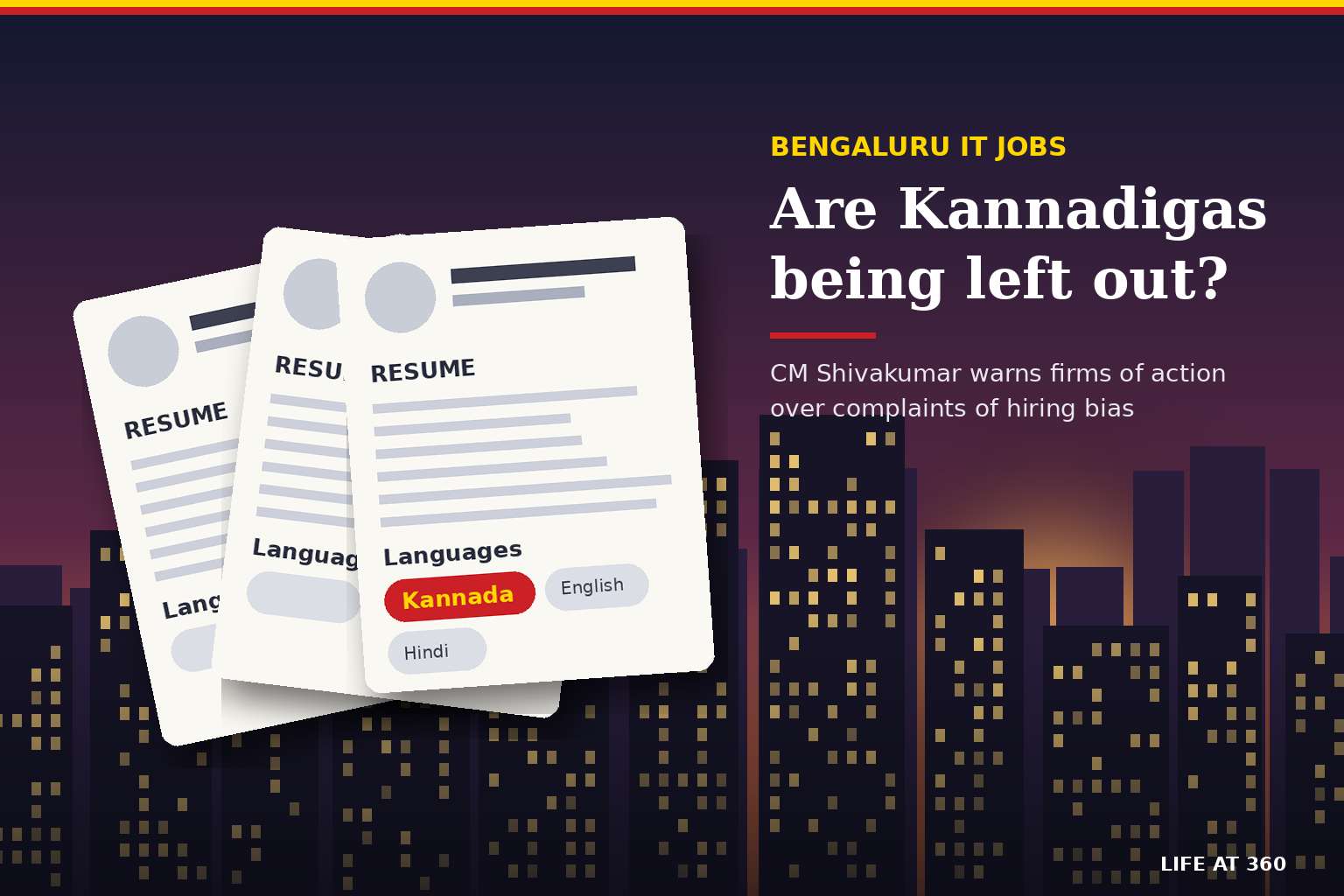
On Sunday morning, Karnataka Chief Minister D.K. Shivakumar did something politicians in Bengaluru tend to do carefully, if at all. He took on the city's IT industry over the question of who gets hired.
In a post on X, written in Kannada and widely translated by news outlets, he said it was disheartening to hear that Kannadigas were being denied jobs at Bengaluru's IT companies. He said his government was treating the complaints seriously. And he warned that if any private institution was found to have deliberately sidelined Kannada speakers, the state would take appropriate action.
It was a short post. But it landed on one of the most sensitive fault lines in the state: the gap between a city that sells itself to the world as India's technology capital, and the people who grew up speaking its language. Many of them feel the boom has been built around them rather than with them.
So what actually happened, what has been proven and what hasn't, and why does this argument keep coming back?
It started with a video
The trigger was a video that began circulating on social media on Saturday, October 24. In it, a young woman from Bengaluru speaks directly to the Chief Minister and lays out a list of grievances that many local graduates will recognise, whether or not they agree with all of it.
Her main claim was striking. She said that some IT companies in the city reject candidates whose resumes mention Kannada as their mother tongue, and that applicants who speak Telugu or Tamil are preferred instead. She went further. According to reports by TV9 Kannada, Public TV and others, she alleged that companies rarely hold campus recruitment drives at Bengaluru colleges, that they go to other states to recruit, and that they hire people from outside Karnataka at lower salaries. The result, she said, was that young people from the state simply weren't getting a fair shot. She ended by asking Shivakumar to find a solution.
Some reports also mentioned job advertisements that asked for Tamil or Telugu proficiency, typically for client-facing or regional support roles, without listing Kannada.
The video spread fast. Kannada organisations, including the Karnataka Rakshana Vedike, publicly demanded that the government act immediately.
There is an important caveat. None of these allegations has been independently verified. The video did not name a single company. There is no public data yet on how many candidates were affected, which firms were involved, or whether "rejected because of Kannada on the resume" reflects a real screening practice or a frustrated reading of a tough job market. Several outlets covering the story, including IBTimes and Public TV, were careful to point this out.
That doesn't make the frustration any less real. It does mean the claims need to be tested before anyone treats them as fact.
What the Chief Minister actually said, and what he didn't
Within about a day, Shivakumar responded. Read closely, his statement was firm in tone but cautious in substance.
He called the complaints disheartening and said the government had taken seriously the issue of native Kannada speakers being sidelined. He described Bengaluru as a city the world sees as India's technology capital and said the state was proud of the talent and skill of Kannadigas. Then came the line that made headlines: "In Karnataka, the Kannadiga is sovereign." He added that the government would not allow the rights, dignity and opportunities of Kannadigas to be disregarded.
The actual warning was conditional. Action would follow only if a private institution is found to have deliberately sidelined Kannadigas. He did not name any company. He did not say what "appropriate action" would mean, whether that is an inquiry, a penalty, a cancelled incentive or something else. Business Today and Free Press Journal both noted that no new policy or enforcement mechanism was announced.
This matters for context. Shivakumar became Chief Minister on June 3, 2026, after Siddaramaiah stepped down in late May. (Some outlets still referred to him as Deputy CM in Sunday's coverage, his old post.) When he took charge, he set out a development agenda that included filling around 56,000 vacant government posts and giving Kannadigas preference in private-sector employment. Sunday's post fits that agenda. It is not, at least yet, a new reservation law.
Karnataka has been here before
Anyone who follows Karnataka politics will feel a strong sense of déjà vu.
In July 2024, the Siddaramaiah cabinet cleared the Karnataka State Employment of Local Candidates in the Industries, Factories and Other Establishments Bill. In its reported form, it would have required private companies to reserve 50% of management roles and 70% of non-management roles for "local candidates". The definition covered people born in Karnataka, or people who had lived in the state for 15 years and could speak, read and write Kannada. Siddaramaiah went further in a social media post, mentioning 100% reservation for Kannadigas in Group C and D jobs. He deleted that post as the backlash grew.
And the backlash was enormous. Nasscom, the industry body for IT companies, said it was seriously concerned and warned that the bill could drive companies away and hurt startups, just as more global firms were setting up capability centres in India. Former Infosys executive T.V. Mohandas Pai called the bill discriminatory and regressive. He argued that if the state wanted more Kannadigas in good jobs, it should spend more on higher education. Biocon's Kiran Mazumdar-Shaw said a tech hub needs skilled talent and that the move should not damage Bengaluru's leading position. Andhra Pradesh's IT minister openly invited affected companies to move to his state.
Within days, the government put the bill on hold for review. It has stayed there.
So when Shivakumar talks about protecting Kannadiga jobs, industry ears prick up. A two-year-old fight hasn't been settled. It has only been paused.
Why the anxiety feels real to many Kannadigas
It is easy, especially on English-language social media, to dismiss these complaints as identity politics. That misses something.
Bengaluru's growth over the last 25 years has been extraordinary, and it has been powered heavily by migration. Engineers from every corner of India, and increasingly the world, have made the city their home. That has brought jobs, money and global prestige. But for many people who grew up in Karnataka, especially those from smaller towns and less famous colleges, the picture looks different. Rents have shot up. Traffic has worsened. The language of the office, the mall and the apartment complex is English or Hindi, not Kannada. And the best-paid jobs in their own capital can feel like they belong to someone else.
The specific complaint about campus recruitment touches a nerve too. Large IT services firms run hiring drives across the country, often at engineering colleges in other southern states with huge graduating batches. If local graduates see recruiters visiting colleges hundreds of kilometres away while skipping theirs, they will draw conclusions, rightly or wrongly.
Then there's the wider job market. Tech hiring has been tight for the last couple of years, with layoffs across the sector and entry-level roles under pressure from automation. Shivakumar himself said at a Network18 event in April that AI could eventually wipe out up to half of jobs in Bengaluru and elsewhere. When jobs are scarce, the question of who gets them becomes much more emotional.
Language pride is also a live issue in the city right now. Over the past couple of years, several viral incidents, from a bank official in Bengaluru refusing to speak Kannada to clashes over signboards, have kept the question of respect for Kannada in the news. The video on Saturday dropped into that atmosphere.
None of this proves that companies are screening out Kannada speakers. But it explains why a claim like that spreads so fast, and why so many people instantly believed it.
The industry's side of the story
The IT industry has not yet put out a detailed response to this specific allegation, but its position on local hiring is well known from 2024.
The core argument is about skills and scale. Bengaluru doesn't just compete with Hyderabad or Pune. It competes with cities around the world for global capability centres and big tech investment. Shivakumar made exactly this point himself at Davos earlier this year, saying Bengaluru now plays in a global league driven by talent. Companies say they hire for specific skill sets, through tests and interviews, and that restricting the pool by birthplace or language would make Bengaluru less competitive, not more.
Industry voices also question the idea that any mainstream company would screen resumes by mother tongue. Most large firms use structured hiring processes and applicant tracking systems, and many have formal diversity and anti-discrimination policies. When a Karnataka minister suggested in 2023 that companies should display how many Kannadigas they employ, Mohandas Pai pushed back, saying firms hire through tests and interviews, not by looking at who a person is.
There is one nuance worth holding on to. Even in large companies, a lot of hiring happens through smaller vendors, staffing agencies and contract recruiters. Practices there are harder to monitor. And some roles genuinely need specific language skills, such as customer support for clients in Tamil Nadu or Andhra Pradesh. An ad asking for Telugu speakers isn't automatically discriminatory. It could simply be a regional support role. But a pattern of quietly filtering out a particular group would be a very different matter.
The legal tightrope
This is where things get complicated for any government that wants to move from warnings to rules.
India's Constitution protects the freedom of citizens to live and work anywhere in the country. Domicile-based quotas in private jobs have struggled in court. The clearest example is Haryana, which passed a law in 2020 reserving 75% of private jobs paying under a set salary for local residents. The Punjab and Haryana High Court struck it down in 2023. That ruling is a big part of why the Karnataka bill froze in 2024. Legal experts warned it would face a similar challenge.
Shivakumar's Sunday statement seems to recognise this. It is framed not as "companies must hire X% locals" but as "companies must not deliberately exclude Kannadigas". That is a much more defensible position. Discrimination is easier to oppose in principle than quotas are to justify.
The catch is that deliberate discrimination is hard to prove. If a company never writes down that it rejects Kannada speakers, the evidence would have to come from patterns in hiring data, testimony from rejected candidates, or internal messages. The state would need a credible, fair way to investigate complaints, and companies would need a chance to respond. Without that, "appropriate action" risks either meaning nothing or being applied arbitrarily, and neither would help job seekers or investor confidence.
What would actually help
If the government is serious, and if the industry wants to put this to rest, there are practical steps that don't require a fight.
Find out what's really happening. A simple complaint channel for candidates, with names and details, would quickly show whether this is a widespread problem, a few bad recruiters, or mostly perception. Anonymous anecdotes on social media can't settle it either way.
Publish some numbers. Companies could share basic, aggregated data on hiring from Karnataka colleges, voluntarily or through an industry body. If local hiring is healthy, the data will say so. If it isn't, everyone has a baseline to improve on.
Bring campus drives back home. Large employers could commit to recruiting at more colleges across Karnataka, including outside Bengaluru, in places like Mysuru, Hubballi, Belagavi, Kalaburagi and Mangaluru. That alone would address one of the video's most specific complaints.
Invest in skills, not just slogans. Mohandas Pai's 2024 point about higher education still stands. Better placement cells, industry-linked courses and English and communication training at state colleges would help local graduates compete for the best roles on merit.
Keep the line clear. Requiring a regional language for a regional role is fine. Filtering people out because of their mother tongue is not. Companies should say this explicitly in their hiring policies, and check that their vendors follow it too.
For job seekers, the advice is plain. Mention the languages you speak. Kannada is a genuine asset for many roles in Bengaluru. If you believe you faced discrimination, document it: the job ad, the dates, the messages. Detailed, verifiable complaints carry far more weight than a viral clip.
The bigger picture
This story is about one video and one social media post, but it points to a much older tension in Bengaluru. The city's success depends on being open: to talent, investment and people from everywhere. Its legitimacy at home depends on people who were born there feeling that the success includes them.
Those two goals don't have to clash. Plenty of Kannadigas work in Bengaluru's tech industry, many in senior roles, and many companies would happily hire more strong local graduates if they found them. But when people feel locked out, they look for someone to blame, and politicians feel the pressure to respond.
Shivakumar's warning is, for now, mostly a signal. It tells Kannadigas he has heard them, and it tells companies he is watching. The next step will reveal more. Will the government set up a real way to investigate complaints? Will industry bodies engage, or go quiet until it blows over? And will anyone produce the data that would show what's actually happening?
Until then, Bengaluru is left with the same question it keeps coming back to: how does a city become global without leaving its own people behind?
Sources: Business Today, Deccan Herald, IBTimes India, Free Press Journal, India TV, UNI, News Karnataka, TV9 Kannada, Public TV English, Indian Opinion, Siasat, Gulf News, People Matters, Udayavani and Trak.in. The allegations in the viral video have not been independently verified, and no company has been named.
Comments
No comments yet — be the first to share your view.
Sign in or create an account to join the discussion.